


A Complete Guide to HSBC Bank Guarantees and Standby Letters of Credit for Global Trade Transactions
International trade has created unprecedented opportunities for businesses to expand into global markets, establish new commercial partnerships, and participate in large-scale projects across multiple industries. However, cross-border transactions also involve financial, contractual, and operational risks that require effective risk management solutions. One of the most widely used financial instruments for reducing these risks is the Bank Guarantee (BG), along with the Standby Letter of Credit (SBLC).
A Bank Guarantee issued by a globally recognized financial institution such as HSBC, where applicable, provides confidence to buyers, suppliers, contractors, and investors by supporting contractual obligations and enhancing financial credibility. These instruments play an important role in facilitating international trade, project financing, government tenders, and other high-value commercial transactions.
At RA Investment GmbH, we assist businesses in arranging Bank Guarantees (BG) and Standby Letters of Credit (SBLC), including instruments issued by internationally recognized banking institutions such as HSBC, where appropriate and subject to bank approval, compliance procedures, and applicable regulations. Our objective is to provide structured financial solutions that help businesses manage risk, strengthen commercial relationships, and support sustainable international growth.
What is a Bank Guarantee?
A Bank Guarantee (BG) is a financial undertaking issued by a bank on behalf of its client. It provides assurance to the beneficiary that the issuing bank will fulfill specific financial obligations if the applicant fails to meet the agreed contractual terms.
Rather than replacing the underlying contract, a Bank Guarantee serves as an additional layer of financial security that helps build trust between all parties involved. By reducing concerns about payment or contractual performance, these instruments enable businesses to negotiate larger transactions with greater confidence.
Bank Guarantees are commonly used by importers, exporters, contractors, manufacturers, suppliers, and investors who require additional financial assurance before entering into significant commercial agreements.
Why Bank Guarantees are Important in International Trade
International business transactions often involve parties operating in different countries, currencies, and legal systems. These differences can increase commercial uncertainty and create concerns regarding payment security or contractual performance.
A properly structured Bank Guarantee helps reduce these risks by providing financial assurance from a reputable banking institution. This added confidence enables businesses to establish stronger relationships with trading partners while supporting smooth execution of international contracts.
Bank Guarantees are frequently used in:
- International import and export transactions
- Construction and infrastructure projects
- Government procurement contracts
- Commodity trading
- Manufacturing agreements
- Equipment supply contracts
- Project financing
- Corporate acquisitions
- Cross-border investment transactions
For many businesses, access to an internationally recognized Bank Guarantee can strengthen commercial credibility and improve opportunities to secure valuable contracts in competitive global markets.
HSBC and International Trade Finance
HSBC has established a longstanding presence in international banking and trade finance, supporting businesses engaged in cross-border commerce across numerous markets. Financial instruments issued by HSBC, where applicable, are widely recognized by many commercial organizations and financial institutions due to the bank’s extensive international banking network and experience in global trade finance.
Bank Guarantee
Among the various types of financial instruments available, Bank Guarantees are often preferred for transactions that require a high level of financial assurance. These guarantees are supported by cash collateral held in accordance with the issuing bank’s requirements, providing additional confidence to beneficiaries involved in significant commercial agreements.
Bank Guarantees are commonly used for:
- High-value international trade contracts
- Project and infrastructure financing
- Commodity trading transactions
- Government and public-sector tenders
- Manufacturing and equipment supply agreements
- Long-term commercial contracts
- Corporate investment projects
By providing a strong financial foundation, Bank Guarantees help reduce perceived commercial risk and support successful negotiations between buyers, suppliers, contractors, and investors.
Understanding Standby Letters of Credit (SBLC)
A Standby Letter of Credit (SBLC) is another widely used financial instrument in international trade. While similar to a Bank Guarantee, an SBLC generally serves as a payment assurance mechanism. If the applicant fails to fulfill contractual obligations, the beneficiary may present documents that comply with the terms of the SBLC to request payment, subject to the governing rules and conditions of the issuing bank.
SBLC are widely accepted in international commerce because they provide flexibility and financial confidence across a broad range of industries.
Common applications include:
- International trade finance
- Import and export transactions
- Equipment leasing
- Energy and infrastructure projects
- Manufacturing contracts
- Mining and natural resource developments
- Corporate financing
- Commercial real estate projects
For businesses operating in global markets, SBLC can strengthen commercial relationships by providing additional financial assurance throughout the life of a transaction.
How RA Investment GmbH Supports International Businesses
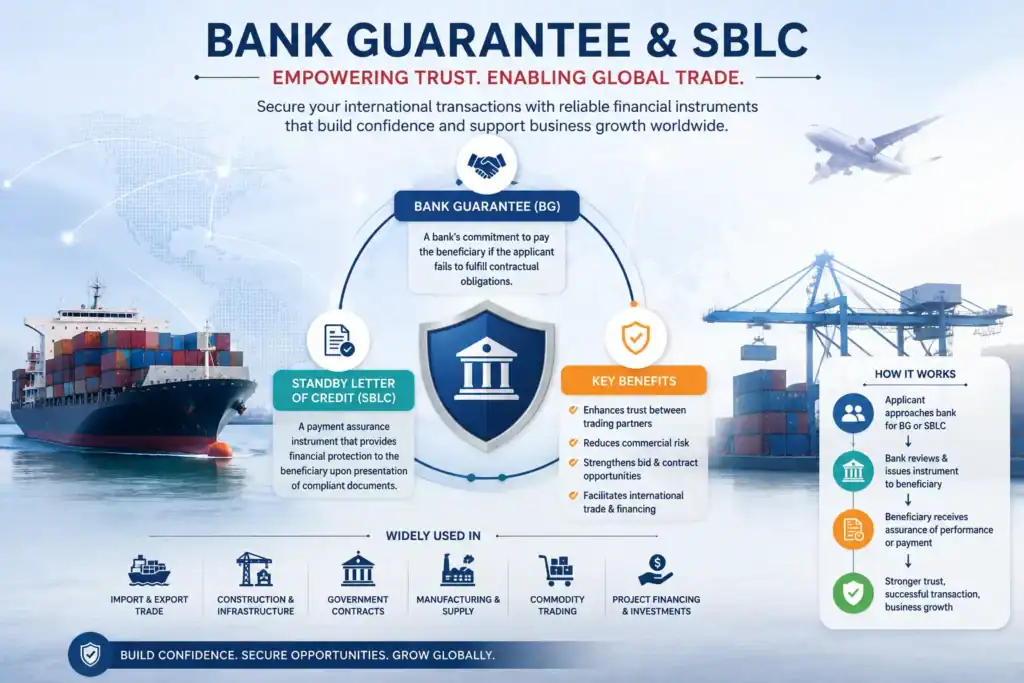
RA Investment GmbH provides structured financial solutions for companies engaged in international trade, project financing, and commercial investment. Every transaction has unique commercial objectives, contractual requirements, and financing considerations, which is why we work closely with clients to understand their specific needs before recommending an appropriate solution.
We assist clients in arranging Bank Guarantee (BG) and Standby Letter of Credit (SBLC), including instruments issued by internationally recognized banking institutions such as HSBC, where applicable. All financial instruments remain subject to bank approval, applicable compliance procedures, and relevant regulatory requirements.
Our objective is to simplify complex financing processes while helping businesses secure reliable financial instruments that support international commercial activities.
Industries That Benefit from Bank Guarantee and SBLC
Bank Guarantees and SBLCs are valuable financial tools across numerous industries where contractual certainty and financial security are essential.
Construction and Engineering companies frequently require Bank Guarantees when bidding for public infrastructure projects or executing major commercial developments.
Commodity Trading businesses use these instruments to enhance confidence between buyers and sellers while supporting high-value international transactions.
Manufacturing companies often rely on Bank Guarantees when purchasing machinery, production equipment, or raw materials from overseas suppliers.
Energy and Natural Resources projects including oil, gas, renewable energy, and mining developments, commonly utilize structured financial instruments to support long-term contractual commitments.
Businesses involved in international procurement, logistics, transportation, and large-scale commercial supply chains also benefit from the additional confidence that Bank Guarantees and SBLCs provide, helping facilitate smoother negotiations and stronger commercial relationships.
Advantages of Financial Instruments
Bank Guarantees and SBLCs provide several advantages for businesses involved in international commerce. These instruments can help companies demonstrate financial credibility, strengthen negotiations, and create greater confidence among trading partners.
Key benefits may include:
- Enhanced commercial credibility
- Increased confidence from suppliers and buyers
- Support for international expansion
- Improved contract negotiation opportunities
- Risk mitigation in complex transactions
- Greater flexibility in structured finance solutions
- Support for large-scale projects and investments
However, selecting the right financial instrument requires careful consideration of transaction requirements, beneficiary expectations, contractual obligations, compliance standards, and applicable banking procedures. Professional guidance can help businesses identify solutions that are aligned with their commercial objectives.
Building Stronger International Business Relationships
Successful global trade depends on trust, transparency, and reliable financial structures. When buyers, suppliers, contractors, and investors have confidence that contractual commitments are supported by recognized banking instruments, commercial discussions can become more efficient and sustainable.
Bank Guarantees and Standby Letters of Credit continue to play an important role in supporting international business growth by helping companies manage risk and participate in opportunities across global markets.
Supporting Your International Trade Objectives
RA Investment GmbH is committed to assisting businesses with structured financial solutions designed to support international trade, project financing, and commercial development. Our team works with clients to understand their requirements and assist in arranging suitable Bank Guarantee and SBLC solutions through recognized financial institutions where appropriate.
By combining financial expertise with a practical understanding of international commerce, RA Investment GmbH helps businesses navigate complex transaction requirements while maintaining a professional and compliance-focused approach.
Whether your company requires support for trade transactions, project development, investment activities, or corporate expansion, structured financial instruments such as Bank Guarantees and SBLCs can provide valuable commercial assurance.
Frequently Asked Questions
What is the difference between a Bank Guarantee and an SBLC?
A Bank Guarantee and a Standby Letter of Credit (SBLC) are both financial instruments designed to provide assurance in commercial transactions. A Bank Guarantee typically provides protection against non-performance or non-payment obligations under a contract, while an SBLC is generally structured as a payment assurance mechanism where the beneficiary may request payment if the applicant fails to meet agreed obligations, subject to the terms and conditions of the instrument.
Who can apply for an HSBC Bank Guarantee?
Businesses seeking a Bank Guarantee issued by HSBC or another recognized financial institution must typically meet the bank’s eligibility, compliance, and financial assessment requirements. The application process may involve reviewing the company’s financial position, transaction structure, business purpose, supporting documentation, and applicable regulatory requirements. Availability is always subject to bank approval.
Are Bank Guarantees transferable?
Whether a Bank Guarantee is transferable depends on the specific terms stated in the instrument and the agreement between the involved parties. Some guarantees may include transfer provisions, while others are issued only for the benefit of a specific beneficiary. Businesses should carefully review the wording of the guarantee before entering into a transaction.
Which industries commonly use SBLCs?
SBLCs are widely used across industries where additional financial assurance is required. Common sectors include international trade, commodity trading, energy, construction, manufacturing, infrastructure development, real estate, and corporate finance. These instruments help businesses strengthen commercial relationships and support transactions involving significant financial commitments.
What international rules govern Bank Guarantees?
International Bank Guarantees are often structured according to recognized banking standards and international rules, depending on the instrument type and agreement between the parties. Common frameworks may include rules published by the International Chamber of Commerce (ICC), such as the Uniform Rules for Demand Guarantees (URDG 758), as well as applicable local banking regulations and contractual terms.
An informative overview of BG and SBLC services. Access to reliable financial instruments is essential for businesses expanding internationally: https://rainvestmentgmbh.com/bank-guarantee-sblc-provider/